Update: Find 2024 auction values here
If you want to access all auction values for free, please inform us by clicking the button below or by filling out the form at the end of the article. Additionally, you can request free custom auction analysis and we will get back to you ASAP! Or click here to view all auction draft tips.
Auction Draft Tips and the Truth About Auction Draft Content
What you will find below is (hopefully) one of the most comprehensive free auction draft articles you have ever read, consisting of common auction draft tips you’ll find on most major publications and some unique tips that most publications fail to highlight. This will ensure we cover all the basic auction draft basic tips for the beginners and maybe even provide some informative notes for the most experienced auction drafters.
My home league, which I am of the commissioner of, has been doing auction drafts for 10+ years. In the past decade I have participated in 50+ auction draft cash leagues and practiced with over 1,000+ auction mock drafts, the latter of which I am not proud of.
Every season I scour search engines, social media platforms, and YouTube for auction draft content, trying to learn anything I can because I simply love auction drafts. From my experiences, the truth is auction draft content is lacklustre and it usually won’t help you in your draft. This article is probably no exception but I’ll do my best.
Why Auction Content is Repetitive and Why It May Not Help You
Before I provide my opinions on auction draft content, I want to make it clear that I don’t fault fantasy football publications for making content that isn’t helpful. It’s honestly just the nature of the format and the target audience. Here are some reasons why I think auction draft content is so inferior to snake draft content and why it’s usually not very useful in your actual draft:
- Snake drafts are more common. It makes sense for analysts to prioritize content that reaches a wider audience, especially since this is the content their audience wants. Therefore, there is much less of a variety/unique auction content available.
- Fantasy football players are usually far more experienced with snake drafts than auction drafts, resulting in analysts producing higher quality content for the format they’re more experienced with.
- Auction values differ greatly by platform and have much less structure than your average snake draft. This makes it harder to provide evergreen analysis as every auction draft is entirely different from another.
- Auction drafts are very situational and many of the generic tips provided can be ignored in certain situations. Content creators have no idea how your draft will flow, so it’s basically impossible to provide insightful advice that applies to the majority. If you’re new to auction drafts, it will be difficult to recognize such situations and using some tips may be hurting you.
- There are only so many auction tips worth noting which leads many publications providing repetitive content. Due to such a lack of content options, it’s difficult to learn new concepts since so much of the content is the exact same, every year.
The Repetitiveness of Auction Tips Found in Auction Draft Content
Most snake draft content is focused on ADP analysis and draft position strategies but auction draft content doesn’t have the same luxury. There is no ADP and no draft position, it’s a free-for-all, and that’s why we love it. Providing strategies based on generic auction values simply isn’t that helpful because rarely does a draft go to plan. Everyone has a plan until they get punched in a face, and auction drafters get punched in the face frequently.
This is why we tend to get content focused on ‘auction tips’ rather than strategic based articles, but this content is far too repetitive, year-after-year. For example, I googled ‘fantasy football auction tips’ and tracked the tips provided from the top six search results (the results you’re most likely to click).
I was quickly able to validate my experiences after seeing how many of the same generic tips were present in each article. Once again, to clarify, this does not mean the article is poor, as I’ve highlighted earlier, there really is a lack of tips available to include. If you’re a beginner, these tips may help, but next year, you will find similar content, maybe worded slightly different, with a new title.
What are the Most Common Auction Draft Tips?
I paraphrased some of the tips found in my top six search results to create common ideas which were present in these articles. I excluded roster building specific strategies such as ‘try stars and scrubs’ and ‘flex WRs in PPR leagues’, additionally excluding filler tips which I don’t think have any value such as ‘have fun’.


- Eight different auction tips are present in at least three of the six publications.
- 7/45 tips provided are unique (found only in one publication) and a few of these are on the weaker side if we’re being completely honest.
All of the above auction tips are certainly worthy of being listed but despite their legitimacy, they really aren’t that helpful to anyone with minor auction draft experience and may even hinder some auction draft beginners.
Below I will discuss some of the common tips and highlight why each is important and their potential flaws.
Common Auction Draft Tip #1: Budget Allocation
Why is this tip important?
- A rough budget plan created pre-draft can be a helpful practice to keep you on track during the draft. For example, FTN suggests a rough budget allocation of 5% for QBs/40% for RBs/45% for WRs/10% for TEs.
- Budgeting for starters vs. bench players is also a strong practice.
- Having a budget plan will help you adjust on the fly. The odds of your budgeting objectives going 100% according to plan are slim. But if you overspend on RBs by 5%, you can quickly identify this and make up that 5% elsewhere. Without a plan, it’s difficult to know when you’re over/under budget.
- A more detailed approach to this concept is making a par sheet which is wonderfully explained in this Footballguys article.
Why this tip may not be helpful
- Sticking to a specific budget plan or even a loose budget plan may reduce your flexibility, ultimately weakening your draft.
- I have witnessed countless managers come to the draft room with an allocation plan strongly weighted on RBs and WRs. Then Travis Kelce and Josh Allen go for 10% less than projected and the same managers complain the cost was too cheap, while they still have 80% of their budget remaining and were too afraid to deviate from their plan.
- Additionally, if you have the same budget allocation every year, smart league members will catch on and know your draft strategy before it’s even started.
Common Auction Draft Tip #2: Create Auction Values
Why is this tip important?
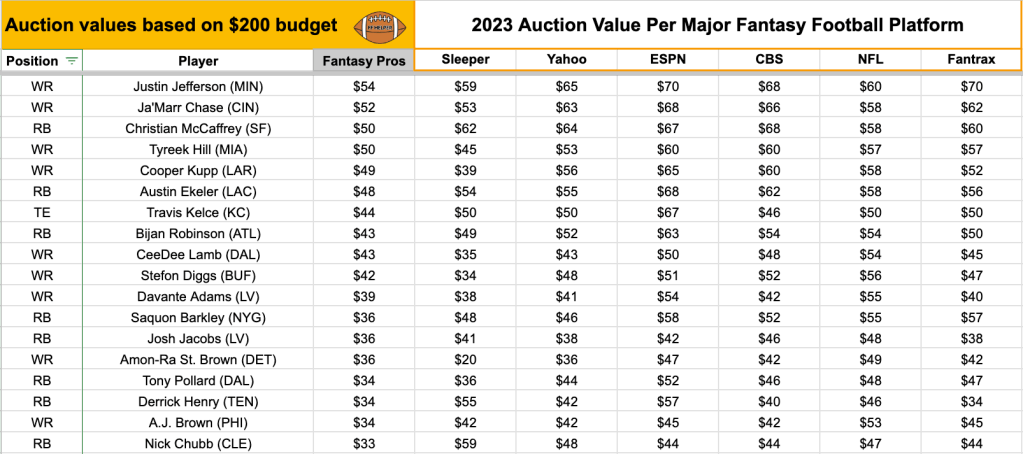
- Auction values vary by platform and sometimes the ranges are so wide, it’s difficult for even the most experienced drafters to decipher the true value of a player.
- Most major platforms provide a projected and average value for each player which are visible in the live draft room, and sometimes these values are so off from reality. Many managers tend to use these draft room figures as a value guideline, especially inexperienced drafters.
- By creating your own auction values, you can easily identify which players are over/under valued. By identifying such players, the potential to win bids for cheaper than average, while simultaneously not overspending is how you can create a super team. FTN Fantasy has a step-by-step method on how-to create auction values using projections and finding the replacement level of each player.
Why this tip may not be helpful
- I have created my own auction values numerous times, each occasion perfecting my process more than before; and each time I abandoned them for the early part of the draft. I’ll say it again, flexibility is key. Sticking too closely to a particular budget, cheat sheet, or value chart may actually weaken your team.
- Here’s a common scenario which happens; All the top players go for 5%-15% more than their expected value which leads to two options: Option 1 – stick to your value chart but miss out on the top 24ish players. Your team will be full of 3rd-6th round players but no studs. Option 2 – you start spending your money, willingly overpaying, and adapting to the room. Eventually you’ll have to acquire some studs and that usually requires paying up.
- Additionally, creating your own auction values is time consuming and tedious. This is overwhelming for many beginners and most experienced auction drafters probably don’t need to.
Common Auction Draft Tip #3: Nominate Players You Want/Don’t Want
Why is this tip important?
- Nomination strategies are critical in auction drafts. Most of the content you’ll read is the same; nominate players you don’t want early and players you do want later.
- The idea is that early on you get managers to spend big money on players you don’t want, reducing their budgets for when the players you do want are available.
- You want to nominate the players you do want in the mid-rounds so if you don’t get them, you have time for a plan B, plan C, etc.
Why this tip may not be helpful
- These tips are legit and using these nominations strategies can’t backfire, however there are numerous situational exceptions when following these tips are not the most optimal.
Common Auction Draft Tip #4: Pay Attention and Monitor Max Bids
Why is this tip important?
- This is obvious but it’s worth noting that you should be paying attention to and monitoring winning bids, team needs, their budgets, and nomination order at all times. Don’t just focus on your own team.
- Max bids become increasingly important as the draft goes on and monitoring the max bid of all teams is essential. If you and another manager both have the highest max bid of $4 and are bidding on the same player, whoever bids $4 first wins. If you nominate a player for $1 and the other manager bids $2, don’t risk bidding $3 and losing, bid $4 and automatically win.
- Later in the draft when it’s mostly $1 players left for all teams, you should have a queue ready for players you want to nominate. Pay attention to your nomination time as some drafts drastically reduce this setting towards the later stages. You never want to auto nominate a player in the late rounds.
Why this tip may not be helpful
- Paying attention is always helpful.
Common Auction Draft Tip #5: Min Bid on K & D/ST
Why is this tip important?
- These roster positions tend to a to have lots of variance week-to-week and using a streaming strategy has proven to be viable.
- Every extra dollar spent on a kicker or D/ST is a dollar that’s not going towards skill positions.
- Every dollar is precious in the late rounds and spending more than the minimum on non-skill positions can handicap you in the final stages of the draft.
Why this tip may not be helpful
- Your skill positions are the roster spots which can smash ADP and become league winners. Sometimes it’s better to not draft a kicker or D/ST at all and draft two more lottery tickets. This gives you more chances to get lucky incase camp battles, injuries, or suspensions vault your player into increased playing time. You can always add a kicker or D/ST right before the season starts.
- There are some instances where a D/ST can be extremely valuable. If you truly believe in a D/ST, it’s a good strategy to bid $2 on them early in the draft. You’re likely to win the bid and if you don’t, another manager had to spend $3+ to acquire them. Every dollar counts.
Common Auction Draft Tip #6: Create Bidding Wars
Why is this tip important?
- Bidding wars can be forced in numerous ways, causing managers to overspend. Bidding wars are created typically by bidding up players you know your league mates want/need or by paying attention (auction tip #4) to a combination of team needs, available players, and recent bid patterns.
- Bidding up players ensures managers don’t get the discounts they desire and sometimes ego gets in the way, resulting in large overpays.
- The safer way to start a bidding war is to nominate the best available players which teams are clearly waiting on, or as draft sharks suggests, follow a bidding war with a high-level player you don’t want.
Why this tip may not be helpful
- There is no worse feeling in an auction draft than getting stuck with a player you don’t want because you tried to ‘bid someone up’. This has obvious risks, so try not to bid up players you don’t want.
- The other scenario of creating a bidding war is essentially the same as nominating players you don’t want (auction tip #3), so it’s kind of redundant.
Common Auction Draft Tip #7: Create Player Tiers
Why is this tip important?
- Groupings of player tiers tend to be more useful than player ranks. For example, from the following group of Joe Mixon, Najee Harris, Aaron Jones, and Rhamondre Stevenson, it’s impossible to predict who will be the best in RB in 2023. However, all of these options can be considered a low-end RB1 or a high-end RB2.
- Using tiers helps identify similar values which enables strategic draft selection. For example, sometimes it’s best to target the cheapest player in a tier since their likelihood of finishing at the top of the tier is just as high as anyone else.
Why this tip may not be helpful
- Be careful not to wait for the last player in a tier as they are likely to be overly expensive. Many other managers will also be using tiers and when there’s one player remaining, managers might panic bid.
- Player tiers are fantastic and I create them myself every draft. I don’t see any potential negatives in doing so.
Common Auction Draft Tip #8: Budget Management
Why is this tip important?
- Budget management consists of several tips including, spend but don’t overspend, save some money towards the end so you can control the room, and spend all your money.
- By following the above tips, you can increase the efficiency of your spending, getting more bang for your buck for the duration of the draft.
Why this tip may not be helpful
- The problem with this tip is that you don’t always need to save your money until the end and sometimes you might have to overspend.
- Don’t be afraid to load up on studs and draft numerous $1 player. This can certainly be a winning strategy.
- If you find yourself under budget, you need to spend that money, all of it. If there’s a player you need and you’re under budget go and get him, within reason of course.
My Favourite Auction Tips from the List
Be Flexible
Found in this article from Fantrax, and also this article from Fantasy Six Pack, ‘Be Flexible’ is probably the best advice I would personally give an auction draft beginner. However, I would change it slightly to ‘Be Flexible but Know Your Stuff”.
Flexibility is worthless if you don’t have a solid understanding of player values, remaining players you want to target, back up scenarios, and a plan for your remaining budget. Your pre-draft road map will unlikely go as planned but the same goes for all other managers. Those who can adapt quickly will have the advantage. With time, this becomes much easier but auction draft beginners really need to do their homework.
Follow Snake Draft ADP Principles
Found only in this fantasy football auction strategy article from Sporting News, is a tip that really helps snake drafters transition to auction drafts. Building an auction draft roster can be very overwhelming for beginners but it doesn’t have to be.
Why do we love auction drafts? Of course it gives us a fair chance at every player and allows us to target any player we want, but I love it because it provides an opportunity to beat snake draft ADP. If we can draft a 1st round player, a 2nd, a 3rd, two 4th round players, and two 5th round players with our first seven picks, we are beating ADP.
If you’re ever unsure of how you’re performing vs. ADP, or which tier of players you should be targeting next, apply snake draft ADP principles to your auction draft. For example, your first winning bid was Justin Jefferson who has an ADP of 1. In a 12-team snake draft, if you selected Jefferson 1st overall, your next picks would be 24 and 25. If you can draft two additional players within the top 25 along with Jefferson, you’re beating or at worst, on par with ADP. If you can successfully achieve this concept the entire draft, there is no doubt you will have one of the strongest teams post-draft.
Auction Tips Not Found in Any Publications
Here are some additional tips I was unable to find inside any publication located on page 1 of my Google search:
Tie Up Money in the Room by Not Nominating High Value Players
One of the most common tips preached about auction drafts is to always nominate high value players you don’t want. This is solid advice but not always the correct move. The following tip is situational, yet extremely effective.
By paying attention to team needs and player tiers, it can be quite easy to identify which teams are waiting on specific players. Usually the player nomination order will loosely follow the default order on the platform, but there’s always a few studs which lag behind and get nominated many spots later.
In this situation, you want to refrain from nominating the high value player as long as possible (unless you want them) because teams waiting will be hesitant to spend their money. Usually these players are the last of their tiers, which results in managers not wanting to spend money on an inferior option, lowering their chance of winning one of the last available high value players.
For example, let’s say AJ Brown who is usually the 7th-10th WR to be nominated and nominated in the top 20 overall, is still on the board at pick 35. Do not nominate him if he is clearly the best WR remaining. If the next best remaining WRs are DK Metcalf, Jerry Jeudy, and Calvin Ridley, the managers waiting on AJ Brown won’t risk spending $20 on the lower tier players when they know they may need $40+ for AJ Brown. Their money is now tied up and there is less competition for other players.
These managers think the longer they wait, the better price they’ll get, but in reality it’s doing more harm than good, reducing their activity, while most likely still paying a premium price for AJ Brown anyways.
Identify Players With Inaccurate Values and Know When to Nominate Them
There will always be a few players on every draft platform that have a value which is much lower than it should be. The reasons for this are mainly because the draft rankings have not been updated recently or a certain platform is just very low on a player in comparison to their competitors.
You need to try and take advantage of this, and if you can’t, ensure nobody else does. For example, Breece Hall has a projected value of $11 on ESPN but an average of $35 on Yahoo, Sleeper, and NFL.com. This value clearly does not reflect the recent news of him being activated off the PUP, creating an inaccurate value.
Since draft rooms list their players in order of projected value, Breece Hall will be very far down the list. The longer the draft goes on, the cheaper players become because there’s less total money available. If you manually scroll down the queue and nominate Breece Hall early, you eliminate any chance of getting him at a discount if by some chance your league mates did not do their homework.
Before your draft, identify all players which you feel are wildly undervalued and make a note which players you want, and those you don’t. Ensure the ones you don’t want or can’t win due to budget restrictions get nominated earlier so nobody gets a massive discount, while keeping your under valued targets on the board as long as possible.
The Flow Chart Concept: Know Which Direction You’re Heading
Technically, this could be noted under ‘Be Flexible but Know Your Stuff’, but I think the concept is worthy of its own section. You don’t have to create an actual flow chart but it’s valuable to know which direction you should head towards based on your start, having an end-game roster in mind for every scenario.
For example, you decided to splurge on two top five WRs, what is the plan for this particular start? What happens if you draft Mahomes and Kelce, spending 40% of your budget on a QB and TE; what do you now do at RB and WR? What if you missed out on the top 18 players, whats your move from there?
You should have a plan for every possible draft start and identify the optimal flow for each going forward. Personally, I build about 5-10 unique mock rosters, each moulded after different starting scenarios. These act as a guideline and help visualize how my optimal team should look at the finish line.


 Fantasy Football Helper
1 thought on “2023 Fantasy Football Auction Values for All Major Platforms”